Command and Control Technologies

Home


Spaceport InSiteTM   

Space Launch Operations Cost Estimator 

User Manual 
Technical Specification

InSite projects operations costs and flight rates for concept-level space transportation architectures.

Features:
  
Suitable for RLV, ELV and hybrid systems
  Ranks cost drivers in drill down fashion
  Requires top-level design choices only
  Detailed processing flow estimates
  Figure-of-Merit operability scores
  Side-by-side comparisons
  Easy-to-use input menus
  Avoids flight rate inputs
  XML import/export
  Windows-based

Launch Site Functions Assessed:
  
Launch
Turnaround
Unique Logistics
Landing/Recovery
Payload Processing
Depot Maintenance
Traffic/Flight Control
Spaceport Functions
Assembly/Integration
Support Infrastructure
Expendable Processing
Operations Management
Community Infrastructure

Cost Estimates Produced (see examples below)
Facility Acquisition (dollars)
GSE Acquisition (dollars)
Fixed Labor (workforce size)
Fixed Material (dollars)
Variable Labor (workforce)
Variable Material (dollars)
Cycle Time (shifts)

Applications:
Spaceport design
Financing analysis
Insurance analysis
Business planning
Launcher selection
Investment analysis
Infrastructure design
Technology prioritization
Launch operation planning
Military operations analysis
Subsystem design & trades
Government policy analysis
Vehicle design and analysis

InSite is a comprehensive launch site analysis tool for predicting launch site acquisition costs, recurring operations costs, and flight rates of new launch vehicle concepts.

operability score screen.gif (63066 bytes)
(Click to enlarge)

InSite produces detailed cost and flight rate estimates for new space transportation concepts based on the planned vehicle architecture and operation concepts. The patent-pending InSite model projects what facilities a new concept will require, how much it will cost to operate and maintain them, and how many people will be required for each operation. From this, InSite calculates how long it will take to prepare the system for flight and how much it will cost to fly.

InSite is fundamentally different than models like NAFCOM and COMET/OCM. InSite produces � rather than requires � the flight rate and estimates operations costs rather than development costs.

Identify Operations Drivers Early. Developed by a team of engineers from NASA, Boeing, Lockheed Martin, and CCT known as "Vision Spaceport," the model hinges on a comprehensive correlation database to measure concept characteristics known to heavily impact flight operations broken down by launch site facility and function. InSite focuses on design and operations features like equipment servicing, difficult access, payload integration, flight reconfiguration, flight/ground interactions and support logistics to identify, quantify, and rank cost and turnaround time drivers of new system architectures.

How it Works. InSite divides launch site operations into 12 functions like payload processing, turnaround, launch, landing and logistics. For each of these functions, the cost algorithm produces seven operability scores for nonrecurring and recurring costs. The scores are logarithmically scaled to span from $100,000 per pound to orbit down to airline-like goals of $1 per pound. The scores are converted to dollars, labor force sizes, and cycle times (see complete list of cost estimates at left).

Industry Standard. The InSite model was developed, calibrated, and used over three years by a broad industry team to establish a software standard for estimating operations costs early in the design process. Originally available only to the internal development team, the model is now offered commercially from CCT. NASA, Boeing, and Lockheed Martin use the model to assess new system concepts, prioritize technology investments, conduct subsystem trades, and formulate detailed operations concepts. A user group is open to all InSite customers as a forum for participating in continued development of this standard



Input (click thumbnails to enlarge)

atlas3 propulsion input.jpg (92768 bytes)

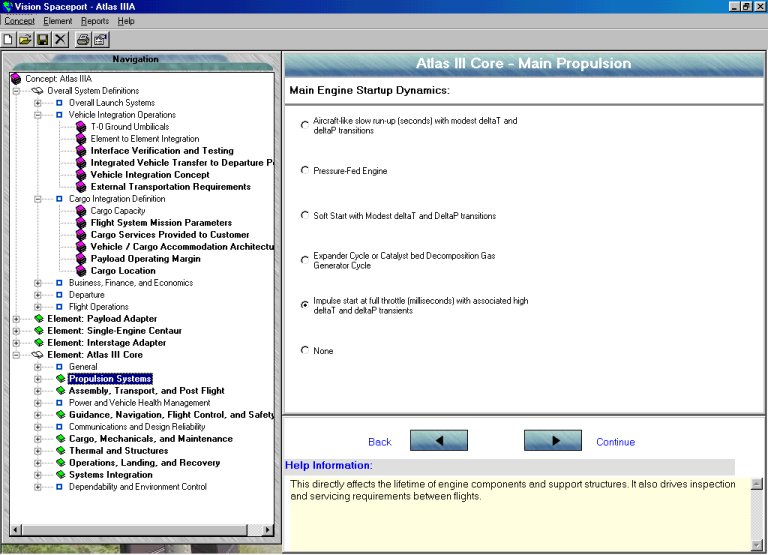
The main input screen provides a wizard-style menu interface with point, click, and type response fields.

input worksheet.jpg (98060 bytes)
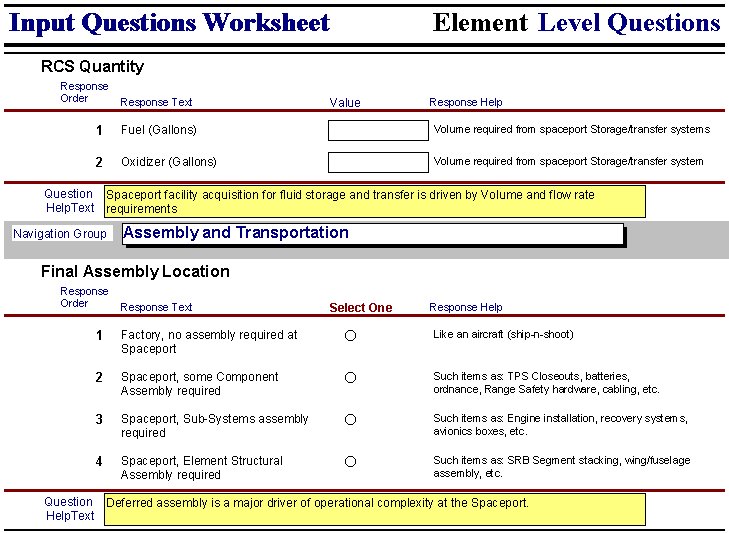
A printable input worksheet report is available to assist with collection and review of input data.

Reports and Results

cost report - apollo.jpg (52202 bytes)

Cost and cycle time estimates are reported for each flight element.

cost report by module.jpg (49290 bytes)

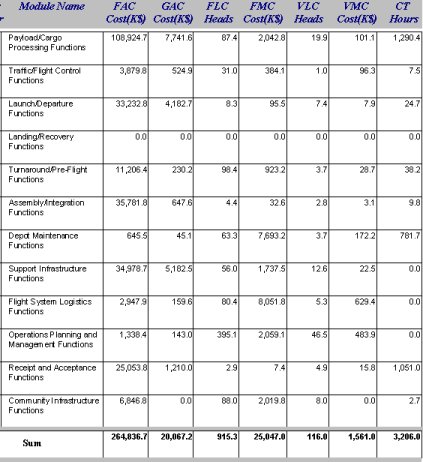
Costs are also broken down by launch site function in a separate report.

op scores.jpg (67046 bytes)

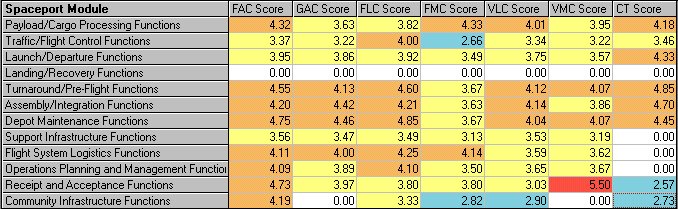
Figures of merit are computed and displayed in this color-coded matrix format to provide a quick visual overview of the strengths and weaknesses of the space transportation architecture concept.


Cost Estimates. InSite produces operability scores on a scale of one to six for each spaceport function and cost category (red arrow indicates cycle time score of 2.48 for the launch function above). Selecting that cell calls up a sorted list of cost drivers contributing to that measure (lower left window) � in this case, the lack of IVHM coverage (red oval) is the largest contributor to launch processing time for this vehicle element.


Model Validation. Engineers from universities, NASA-MSFC, the U.S. Air Force, FAA, and contractors spent five weeks assessing the validity of the model prior to its final release. The results of their assessment are available online.


F44-01-InSite-121202


Home    Products & Services    Technical Support    News & Events  Careers    Contact Us

Copyright � 2002 Command and Control Technologies Corporation. All rights reserved.